

Grey Blending vs Grey Blonding: What's the Difference and Which One Is Right for You?

Let's clear something up straight away.
When clients hear the words "grey blending," a look of panic tends to cross their face. They imagine walking out of the salon looking like their nan. They picture themselves surrendering — to age, to grey roots, to a life of sensible shoes and early bedtimes.
That's not what grey blending is. Not even close.
Grey blending is one of the most flattering, low-maintenance colour techniques available right now — and for blondes especially, it can be genuinely transformative. But it gets confused with "going grey," and that confusion is costing a lot of women a technique that could actually make their life easier and their hair look better.
So let's break it down properly.
What is grey blending?
Grey blending is a colouring technique designed to work with your natural grey rather than fight it.
Instead of covering every strand of grey with a solid colour (which grows out fast, shows roots obviously, and requires constant upkeep), grey blending uses highlights, lowlights, and toning to soften the contrast between your grey and your natural colour. The grey doesn't disappear — it gets woven into the overall look so seamlessly that it just reads as... dimension. Depth. That expensive, editorial kind of texture that people assume takes hours and costs a fortune.
It doesn't mean going grey. It means managing grey cleverly.
What is grey blonding?
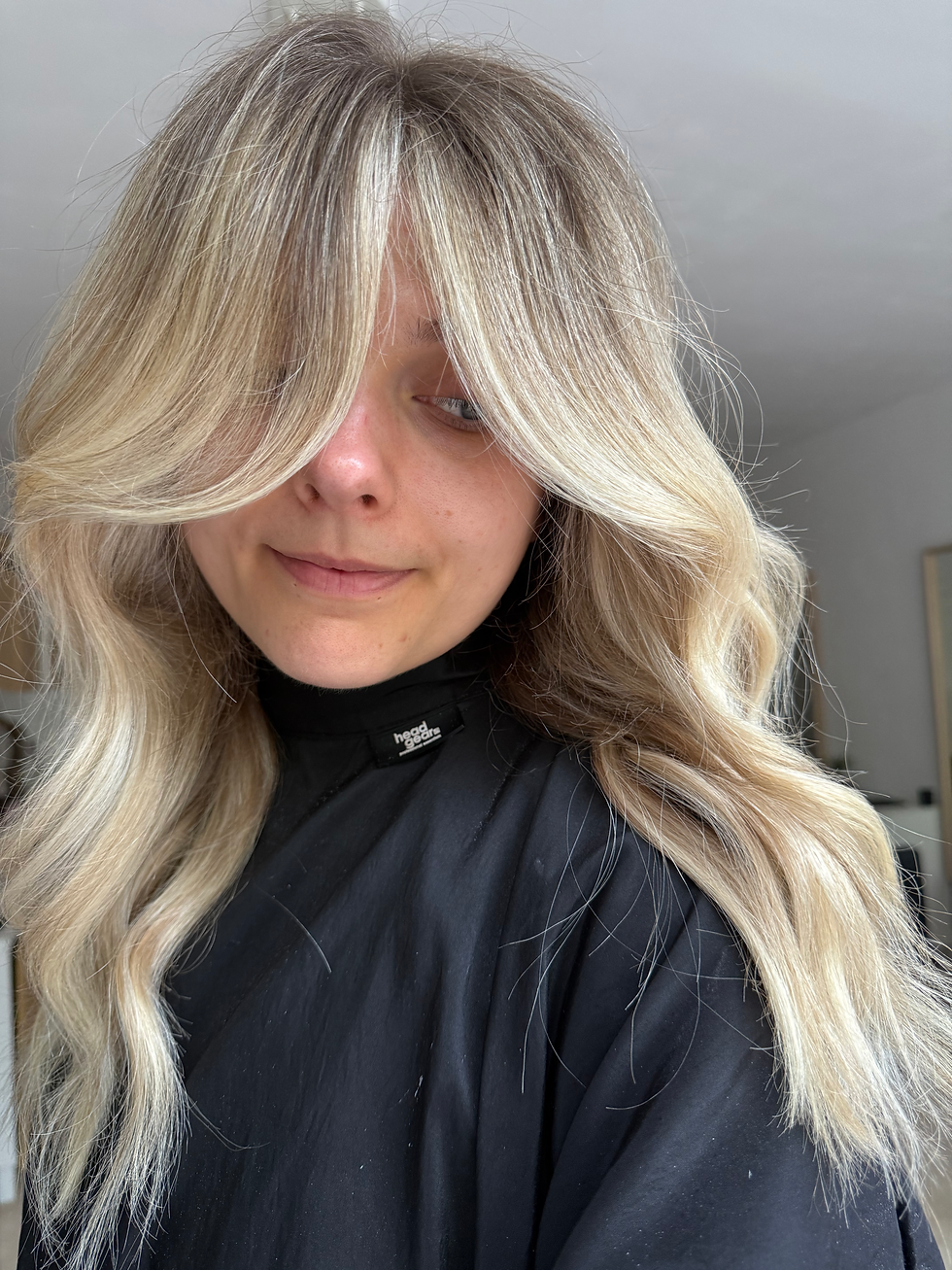
Grey blonding is the blonde specialist's version of this — and honestly, it's where the magic really happens.
If you're naturally blonde or colour-treated blonde, you have a significant advantage when it comes to grey. Grey hair is light. Blonde hair is light. They're actually not that far apart on the colour spectrum, which means a skilled colourist can lift and tone your existing colour to meet your grey halfway — making the whole thing blend into a seamless, sun-kissed result.
In practice, grey blonding typically involves:
Lifting the hair lighter around the areas where grey is most prominent (usually the hairline, parting, and temples)
Toning to create a cohesive, cool or warm blonde that unifies grey and coloured strands
Strategic placement so the grey doesn't cluster or create a visible line of demarcation
The result? You look like you've been on holiday, not like you've given up.
So what's the actual difference?
Think of it this way.
Grey blending is the broader term — it's the philosophy of working with grey rather than against it. It applies to brunettes, redheads, and blondes alike.
Grey blonding is the blonde-specific version — where we use lightening techniques to bring your colour up to meet the grey, rather than pushing the grey down with dark, heavy colour.
Both techniques result in lower maintenance. But grey blonding, for the right candidate, can actually make your grey virtually undetectable — because you're not hiding it, you're matching it.
Who is grey blonding for?
If you tick most of these boxes, you're likely an excellent candidate:
You're naturally blonde or have been colouring your hair blonde
You're starting to see grey at the hairline, parting, or temples
You're tired of being in the salon every 4–6 weeks for root touch-ups
You want your hair to look expensive and effortless rather than obviously coloured
You're open to going a little lighter than your current shade
Grey blonding tends to work particularly well for women in their late thirties, forties, and fifties — but age is genuinely irrelevant. What matters is your hair's current condition, your natural base, and what you want your maintenance schedule to look like going forward.
Why blondes have the advantage
Here's the honest truth about grey and dark hair: covering grey on a dark base is a commitment. The moment your roots come through, the contrast is stark. You're back in the salon quickly, and if you ever want to transition away from colouring altogether, the grow-out process can be lengthy and difficult.
Blondes don't have that problem to anything like the same degree.
Because blonde colour sits so close to the tone of grey hair, the grow-out is gradual and forgiving. A well-placed grey blonding service can give you 10–14 weeks between appointments without looking like you've forgotten to book in. For some clients, even longer.
That's not just convenient — it adds up to a significant saving over a year.
What to expect from a grey blonding appointment
Every client is different, but here's a general idea of what the process looks like.
We'll start with a consultation to look at where your grey is sitting, how much of it there is, and what your current colour history looks like. From there we'll map out a placement strategy — usually focusing the lightness around the areas of highest grey concentration so that the two blend naturally.
Depending on your starting point, we may use a combination of freehand balayage, foil highlights, and a toner to achieve the result. For some clients it's a single appointment. For others, particularly those making a bigger shift in colour, it may be a two-stage process.
Either way, the goal is the same: hair that looks considered, healthy, and naturally beautiful — with a maintenance schedule you can actually live with.
The bottom line
Grey blending doesn't mean going grey. It means being smarter about grey.
And for blondes, grey blonding is one of the most flattering techniques available — because instead of fighting your natural changes, you're working with them. Going lighter, not darker. Leaning into the luminosity rather than trying to smother it.
If you're spending every six weeks stressing about your roots, it might be time to have a different conversation about your colour.
We'd love to talk you through whether grey blonding could work for you. Book a consultation and let's take a look.


Comments